
CONSULTING SURVEYORS NATIONAL'S INDUSTRY RESEARCH
To ensure any current or potential issues faced by the surveying profession can be accurately and effectively resolved, CSN is committed to undertaking quality nationwide industry research.
The Association has commissioned research into industry trends, with this research then used to formulate action plans and strategies for the resolution of issues raised.
We have also provided research from other organisations which are relevant to the surveying profession.

DIGITAL TWIN: the Age of Aquarius in construction and real estate - May 2021
A number of experts in the digital twin technology field from EY (part of Ernst & Young Global Limited) have co-authored this white paper which outlines the case for the adoption of digital twin technology to transform the built environment and revolutionise the construction and real estate industries.
It's a fascinating insight into how digital twin - "a virtual representation of real-world entities and processes, synchonized a specified frequency and fidelity" - enables a physical building to adapt to human needs, instead of the human conforming to the building's limitations. Digital data is able to deliver actionable insights geared toward efficiency, shile reducing wasted resources.
Digital twins are becoming the market differentiator that will have the greatest impact on building efficiencies, cost optimization, operational intelligence and decarbonisation.

The Profession can Contribute to a Sustainable Future
How the global pandemic and sustainability trends have become a huge opportunity for Consulting Surveyors
by Willem Overbosch, SDG Align
The global pandemic, extreme weather conditions in Australia and growing consumer awareness for sustainability have emphasised the urgency for environmental, societal and economic change towards a new way of working and living. The United Nations Sustainable Development Goals (SDGs), approved in 2015 by 193 nations, are a global framework of 17 ‘wicked problems’ that require governments, civilians and private sector to solve in partnership.
The aspiration is to create global solutions towards 2030—solutions that eliminate poverty, care for the environment and leave no one behind. According to a 2019 global survey from the World Economic Forum, Australia is currently listed number 37 on the Global Sustainable Development Report rankings1, with nearly 60 per cent of the general public unfamiliar with the content of the SDGs. And that's quite substantial if you compare it to the global average, which is only 42 per cent. So there's a lot of room for improvement.
There is also a lot of knowledge to be shared with industry sectors in the build environment, especially as the built environment is responsible for over 37 per cent of global CO2 emissions and one of the largest polluters in the world2.
Some members of Consulting Surveyors National (CSN) are already committed to these goals, but many, like most Australians, are not aware of the SDGs. We need to be asking questions such as ‘what is the impact of the SDGs for the built environment’?, ‘how can CSN help to build partnerships for change and lead the profession towards a more sustainable future?’ and ‘how can the SDGs help to solve the workforce challenges the surveyors have in the near future?’.
With these questions in mind, CSN teamed up with SDG Align—a consulting organisation delivering sustainable social impact solutions—to explore the opportunities surrounding the implementation of the SDGs in the built environment.
CSN formed a Sustainability Task Force comprised of 15 industry leaders, academics and corporate sponsors who, during a 90-day period from October through to December 2020, participated in sessions facilitated by SDG Align Consultants to create a ‘5-step bold vision’. Using digital whiteboards from Miro.com, this vision was created for the establishment of the SDGs into the profession.

Al: Construction's new frontier of digital enablement
Digital automation accelerates operational efficiency
For years, construction has lagged behind other industries regarding technological advancement, disruption and digital automation. Finally, this is starting to change. The reducing cost of digital enablement, staffing challenges and the increasing complexity of business is forcing disruption upon the industry. Of all the digital technologies, automation holds out the most promise for achievable digital enablement. Automation can be defined as the use of machines and computers that perform tasks without needing human control. This approach provides an extraordinary capability to process and organise massive quantities of data in a fraction of time compared to manual execution while operating 24 hours per day.
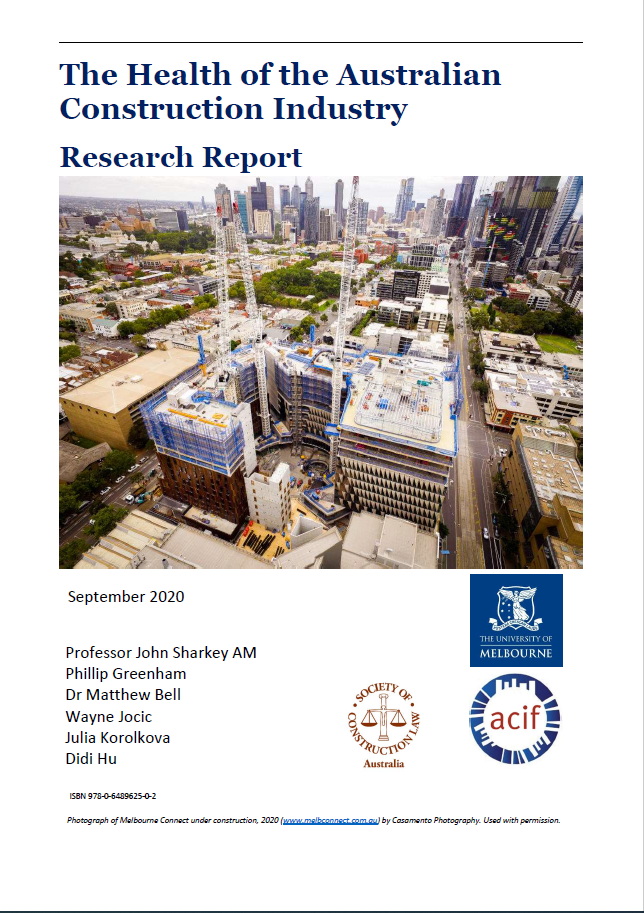 2020 "The Health of the Australian Construction Industry" Research Report by Melbourne Law School, University of Melbourne
The Construction industry in Australia generates over A$360 billion in revenue, producing around
9% of Australia’s Gross Domestic Product. In 2019, over 1.15 million people were employed in
the construction industry (being 9.0% of the Australian workforce). Governments at all levels
spend a significant amount on construction and infrastructure and this amount is increasing.
Given this landscape, it is appropriate to pause and consider the health of the Australian
construction industry. This research project did just that. The authors’ intention was to ‘take the
temperature’ of the industry and identify areas which might benefit from further research and
consideration, with a view to maximising the prospects of the community, and the industry,
enjoying the best return it can on the very significant investment made in the industry.
2018 "Determining the Future Demand, Supply and Skills Gap for Surveying and Geospatial Professional" by BIS Oxford Economics
Prepared for Consulting Surveyors National, the report provides a thorough analysis of the critical and far reaching issues surrounding the demand and supply of surveying and geospatial professionals – issues which have a profound effect on the property and construction industry and Australia’s present and future economy.
With the potential to reshape the profession, legislation and future surveying education, media and government representatives will be attending the launch to fully understand and discuss the implications of this research.
As a key business owner and stakeholder in the Surveying profession, be part of this discussion to lead and shape your industry and ensure the longevity of the construction and property industry.
The focus will be on how the profession and government tackles significant workforce gaps, which are severely impacting private house commencements, utilities and transport construction, multi-residential and non-residential buildings, plus mining and heavy industry construction.

2016 PwC Report into the Value and Benefits of Registering Land Surveyors
Commissioned by CSN in late 2016, the outcome of this research clearly shows that the risks associated with removing a registration system are great. Confidence in the Australian land tenure system, which supports the efficiency of the Australian economy, stems from maintaining the integrity of the cadastre. A licensed surveyor is imperative to the conservation of this integrity.
To read the PwC report into the value of the Land Surveyors Registration system, click here.
 2014 BIS Shrapnel Report identifies shortfall in Surveyor Numbers & Updated Skills Gap Study For Surveyors and Geospatial Professionals 2014-2024:
Commissioned by CSN, the latest BIS Shrapnel research report into the shortfall in future Surveyor numbers paints a very real picture of the state of Surveying around Australia. The initial study conducted by BIS Shrapnel in 2012 identified that the overall demand for surveying skills is generally correlated with the construction cycle. Therefore the predicted pick-up in construction in the next decade will lead to increased demand for surveying skills. This, combined with a lower existing workforce due to aging, will open up a workforce gap for all surveying and surveying-related professionals. This initial report presented a workforce capability analysis for planned and forecast development requirements across Australia and in New South Wales and Victoria, with the updated report expanding this analysis to cover South Australia and Queensland.
This will help ensure that workforce planning of constituent members is informed by the most current data, and up-to-date information is available for use with industry stakeholders and tertiary providers across Australia.
To read the Updated Skills Gap Study for Surveyors and Geospatial Professionals 2014-2024 please click here.
To access the original 2012-2022 Report, please click here and a Media Release on this study can be accessed here.

(4).png)